
A catalytic converter’s scrap value can range from fifty dollars to well over a thousand, depending entirely on what’s inside it, not on the car it came out of. Without knowing what’s driving that number, it’s easy to accept whatever a buyer offers. Selling a converter on its own has also gotten more complicated, since Alberta tightened the rules on these transactions in 2025, and handling it yourself now comes with paperwork.
Understanding the metals actually inside your converter, and the rules now in place, replaces that guesswork with a number and a process you can trust. This guide breaks down what determines catalytic converter scrap value, current market prices, and the legal requirements that now apply in Alberta before you sell.
Get a Free Quote
If you’d rather not deal with removing a converter, testing it, or navigating the current paperwork requirements yourself, selling the whole vehicle is the simpler path, since the converter’s value is already factored into your offer. Junk Car For Cash buys vehicles in any condition across Calgary and 40+ Alberta communities, with free towing and payment on pickup. Email [email protected] or fill out the form for a free quote.
What Determines Catalytic Converter Scrap Value
Catalytic converter scrap value comes down to two things: which precious metals are inside, and what those metals are trading for right now.
The Metals Inside
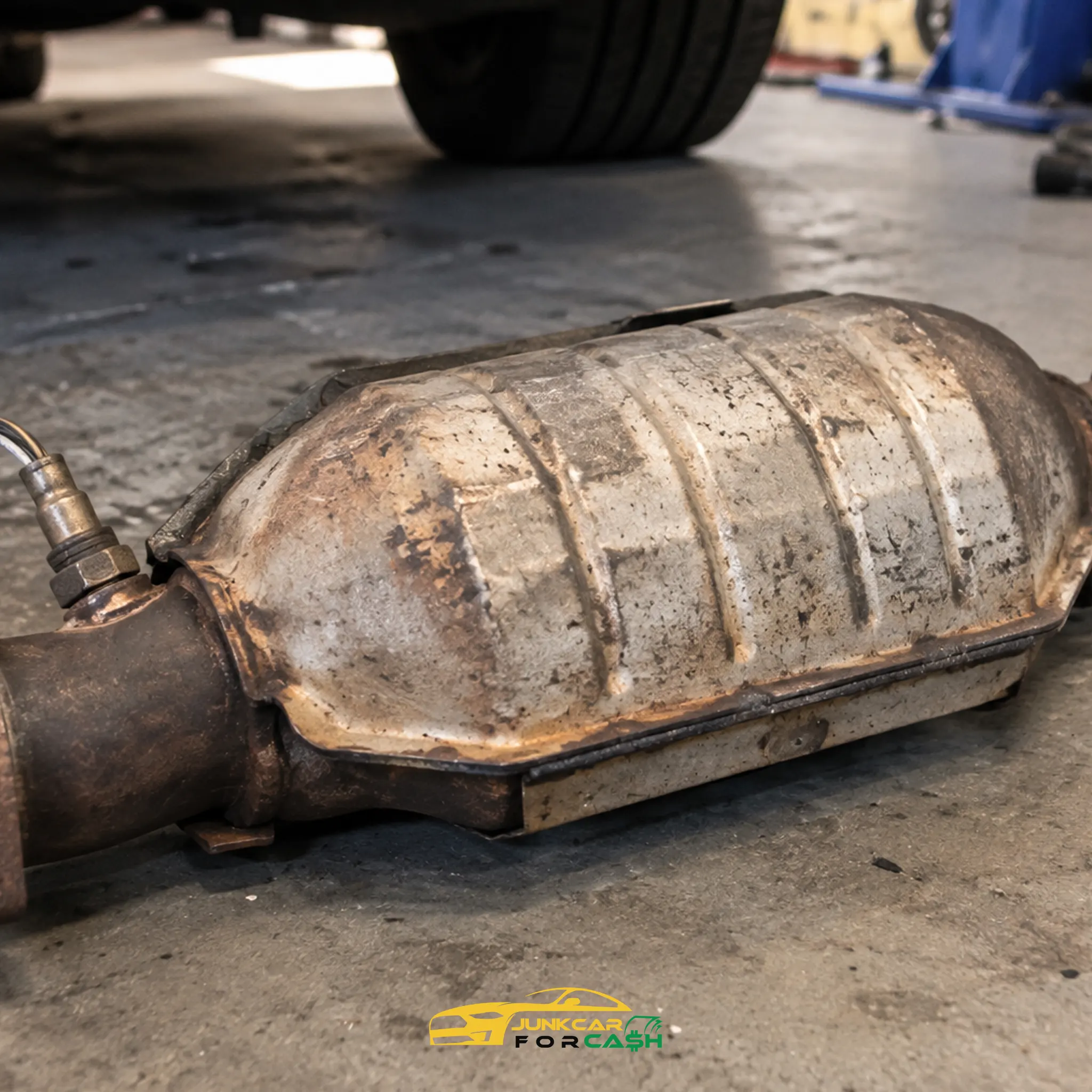
A catalytic converter cleans exhaust gas by passing it over a ceramic honeycomb coated in platinum, palladium, and rhodium, three metals from a group known as platinum-group metals, or PGMs.
These metals are mined in far smaller volumes worldwide than gold, and a meaningful share of the global supply, palladium especially, is recovered as a byproduct of nickel and copper mining rather than as a dedicated target. That scarcity is the real reason a thin coating on a part built years ago is still worth real money today.
Platinum and palladium oxidize carbon monoxide and unburned hydrocarbons into less harmful gases, while rhodium’s job is reducing nitrogen oxides, the pollutant most responsible for smog. That division of labor is why a converter needs all three metals rather than substituting a cheaper one, and why rhodium has stayed in constant demand even as automakers have tried to reduce how much of it they use.
Current Market Prices
The three metals don’t trade anywhere near the same price, and the gap between them is large. As of early September 2026, platinum was trading at roughly $1,750 to $1,775 USD per ounce, palladium at roughly $1,320 to $1,360 USD per ounce, and rhodium, by far the rarest of the three, at roughly $8,600 to $9,750 USD per ounce.
Precious metals are priced in USD globally by convention, the same way oil and gold are, regardless of where the metal is actually bought or sold. These prices also move daily on global commodity markets, so any figure you see, including these, is only accurate for the day it was checked.
How Much Metal Is Inside a Converter?
The amount of precious metal packed into a converter is the single biggest factor behind catalytic converter scrap value, and that amount varies far more than most people expect.
Typical Metal Content by Vehicle Size
A single figure can’t capture that, because actual metal content varies enormously by vehicle. Recycling-industry testing puts recoverable platinum-group metal content in the following rough ranges:
| Vehicle Size | Typical Recoverable PGM Content |
|---|---|
| Small or Compact Car | Roughly 1 to 2 grams |
| Typical Passenger Vehicle | Several grams, more than a small car and less than a large truck |
| Large Truck or SUV | Roughly 12 to 15 grams |
A Hypothetical Value Calculation
Here’s what a converter in that middle range could mean in dollar terms, using the metal prices above as a hypothetical illustration only, not a quote or an average: suppose a converter held 3 grams of platinum, 3 grams of palladium, and 1 gram of rhodium. That would contain roughly $170 of platinum, $130 of palladium, and $290 of rhodium at current spot prices, for about $590 USD in contained metal value.
At the exchange rate in early September 2026, of roughly $1 USD to $1.39 CAD, that works out to around $820 CAD.
That $820 CAD figure isn’t what a buyer would pay you. It’s the value of the metal itself, before refining costs, before the margin a buyer needs for the uncertainty of not knowing your exact converter’s true loading without testing it, and before the exchange rate itself moves, which it does daily along with the metal prices.
What it does explain is why rhodium, present in the smallest quantity of the three, is usually the single biggest driver of a converter’s price.
Testing with XRF Analysis
Handheld XRF analysis, the same x-ray fluorescence technology used in industrial metals testing, offers a more precise alternative to matching a converter to a vehicle make and model. It can scan an intact converter for a fast, non-destructive estimate of its platinum, palladium, and rhodium content.
A more precise reading, the kind a refinery uses to calculate a final payout, generally means opening the converter and grinding the catalyst material into a uniform sample first, since the coating isn’t spread perfectly evenly inside. Either way, testing beats guessing from the vehicle alone, since two converters from the same production line can carry different amounts of catalyst coating depending on when in the model year they were built.
Why Two Similar-Looking Converters Can Differ in Price
Beyond raw metal content, a few other variables shift catalytic converter scrap value even between two units that look nearly the same.
OEM vs. Aftermarket
A factory-installed converter is built to meet the manufacturer’s original emissions certification, which requires enough precious-metal loading to pass testing across the vehicle’s full warranty period.
An aftermarket replacement only needs to meet a less demanding compliance standard, so it’s built with the minimum PGM loading that clears it. The practical result is that an aftermarket converter is worth a small fraction of what the OEM unit it replaced was worth, regardless of the vehicle.
Condition
A cracked, contaminated, or partially melted ceramic substrate loses recoverable metal, since some of the coating flakes off or fuses to the honeycomb in a way standard processing can’t recover. A clean, intact unit yields closer to its full theoretical content; a damaged one yields less, even from an otherwise identical vehicle.
Vehicle Type
Hybrid vehicles cycle their engines on and off rather than running continuously, which means the converter runs cooler and less steadily than in a conventional car.
To keep working effectively at those lower, less consistent temperatures, manufacturers build hybrid converters with a richer load of precious metal than a comparable non-hybrid unit needs. This is a well-documented pattern in vehicles like the Toyota Prius, though it isn’t a rule that applies evenly to every hybrid model or year.
Fuel Type
A diesel engine’s exhaust system generally relies on oxidation catalysts and particulate filters rather than the three-way catalyst design used in gasoline engines, and uses far less rhodium relative to platinum as a result. A large diesel converter can look impressively big without holding anywhere near the value of a smaller gasoline unit, since size alone says nothing about which catalyst technology, or how much of which metal, is inside it.
Alberta's Rules for Selling a Catalytic Converter
Alberta has specific, currently in-force requirements for selling a catalytic converter on its own, separate from selling it as part of a whole vehicle.
Provincial Requirements
Amendments to the Scrap Metal Dealers and Recyclers Identification Act came into force on September 1, 2025. Since then, a dealer or recycler buying a catalytic converter must record the seller’s government-issued photo ID, use a traceable payment method rather than cash, and collect the converter’s vehicle identification number or other proof of ownership, then report the transaction to a centralized law enforcement database.
Calgary's Additional Requirements
Calgary layers its own requirements on top of that. Under changes to the city’s Business Licence Bylaw that took effect in mid-2023, salvage yards, auto wreckers, and, as of 2024, auto body and repair shops that buy used parts:
- Cannot accept a converter with its identifying markings removed or defaced
- Must record the vehicle’s VIN, make, model, colour, and year
- Must keep the seller’s identification and transaction details on file for one year
None of this makes selling a catalytic converter on its own illegal. It just means it now takes more paperwork and identification, at both the provincial and municipal level, than it used to.
Why the Rules Changed
These provincial rules aren’t new territory that appeared out of nowhere. A version of Alberta’s scrap metal identification requirements was challenged in court in January 2025, when the Alberta Court of Justice found parts of the previous law violated Charter protections against unreasonable search.
The amended version now in force addressed that ruling, but the rules shifted meaningfully within the past two years, which means older articles describing Alberta’s scrap metal law may be describing a version that’s no longer in effect.
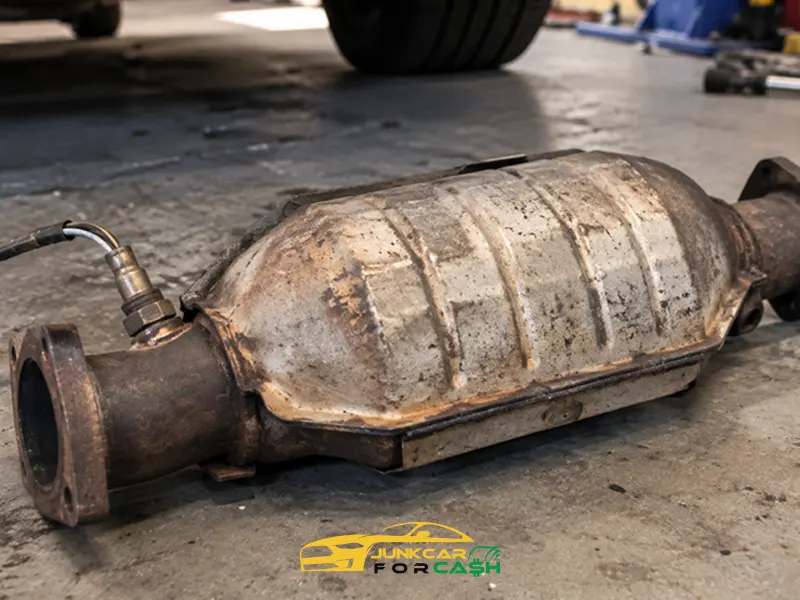
Why Selling the Whole Vehicle Usually Beats Selling the Converter Alone
Given those requirements, pulling a converter off a vehicle to sell separately is rarely worth the extra steps for a car that’s headed to scrap anyway. You still need the ID, the VIN documentation, and a buyer equipped to handle a regulated transaction, on top of the physical labor of removing the part yourself, which usually means lifting the vehicle and cutting or unbolting the converter from the exhaust system.
Selling the vehicle intact folds the converter’s value into a single offer instead. You’re selling a vehicle, not an unattached catalytic converter, so the buyer, already a licensed party set up to handle scrap transactions, accounts for the converter’s estimated value in the quote and takes the removal and any related paperwork from there.
In our experience, vehicles that arrive with the catalytic converter already removed or stolen get a lower offer than an otherwise identical vehicle with the converter intact, which is usually the clearest sign of how much of a scrap car’s value that one part can represent.
FAQs
Get a Free Quote
If you’d rather not deal with removing a converter, testing it, or navigating the current paperwork requirements yourself, selling the whole vehicle is the simpler path, since the converter’s value is already factored into your offer. Junk Car For Cash buys vehicles in any condition across Calgary and 40+ Alberta communities, with free towing and payment on pickup. Email [email protected] or fill out the form for a free quote.
The Bottom Line
A catalytic converter’s value comes down to the platinum, palladium, and rhodium inside it, not its size or the vehicle’s age, and those three metals trade at very different prices, which is why a rough estimate without knowing the actual metal content is really just a guess. Add in Alberta’s current identification and reporting requirements for selling a converter separately, and the simpler path for most people scrapping an old vehicle is to let the buyer factor the converter into one offer for the whole car.
References
Government of Alberta. Scrap metal transactions. alberta.ca: https://www.alberta.ca/scrap-metal-transactions
City of Calgary. Catalytic converter transactions. calgary.ca: https://www.calgary.ca/for-business/licences/catalytic-converter-transactions.html
Harrison Pensa LLP. Scrap metal law struck down for privacy violations (analysis of R v Khairullah). harrisonpensa.com: https://www.harrisonpensa.com/scrap-metal-law-struck-down-for-privacy-violations/
Lemberge, P. (2024, updated 2026). EDXRF Measures Platinum Group Metals in Automotive Catalytic Converters. Thermo Fisher Scientific, citing USGS Mineral Commodity Summaries 2023: https://www.thermofisher.com/blog/metals/edxrf-measures-platinum-group-metals-in-automotive-catalytic-converters/
ScrapMonster. Current Catalytic Converter Scrap Price and Precious Metals Market Prices (accessed September 2026): https://www.scrapmonster.com/catalytic-converter-scrap-price