
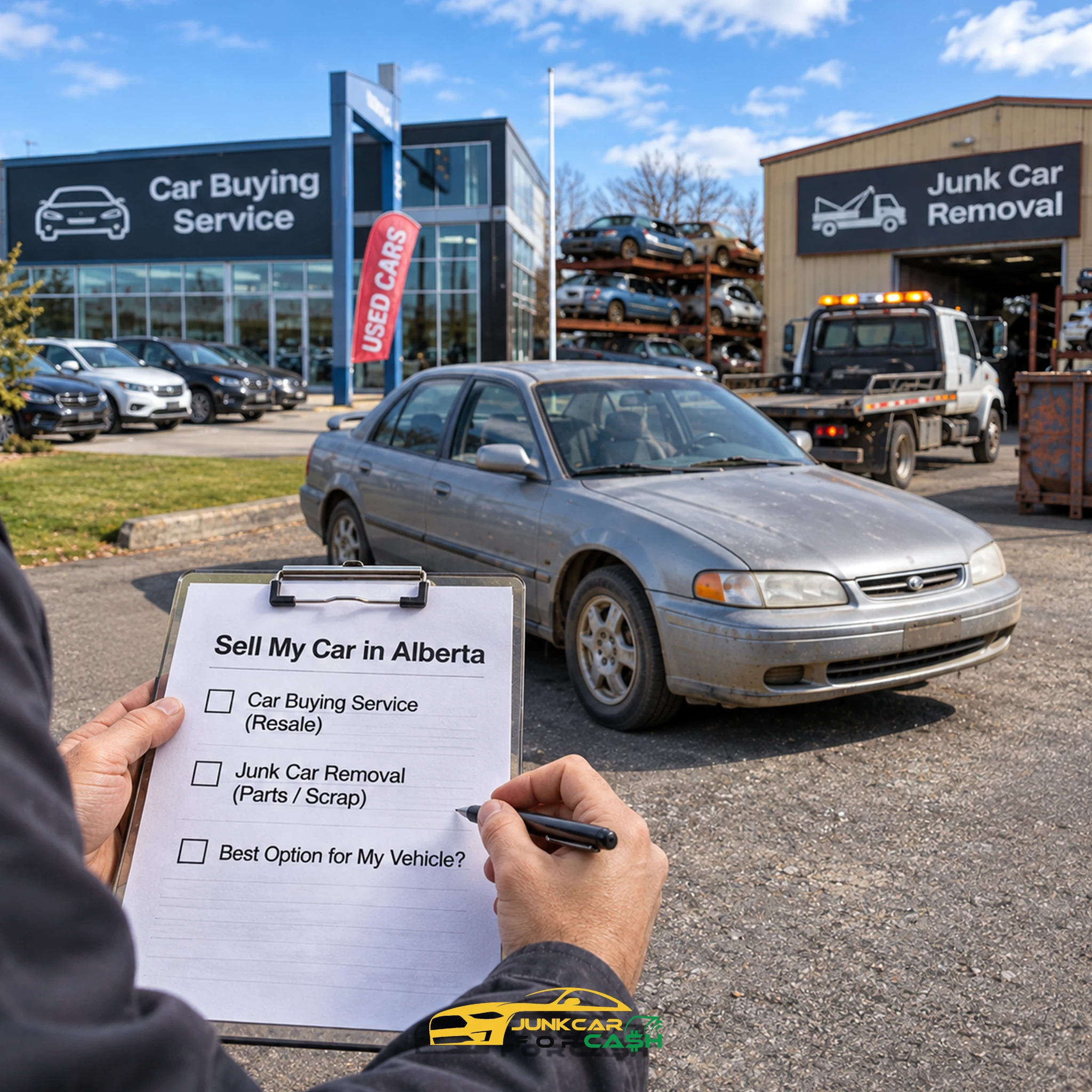
Every vehicle sold in Alberta ends up somewhere: back on a retail lot, across an auction block, or in a dismantler’s yard. Sellers rarely ask where theirs is headed, so they compare quotes from buyers who are shopping for entirely different things. A resale buyer wants a car it can put in front of a driver, while a removal buyer wants the steel, the parts, and a vehicle it can haul away. That destination shapes what each buyer can pay, what the buyer owes the next person in the chain, and how long the sale takes. This guide follows the vehicle downstream to explain car buying services vs junk car removal in Alberta and to show which route fits yours.
Not Sure Where Your Vehicle Is Headed? Get a Free Quote
If your vehicle is damaged, non-running, or past the point a resale buyer wants, Junk Car For Cash can give you a free, no-obligation quote, with free towing and cash at pickup. Call (587) 325-0717 or email [email protected] to get started.
What Is the Difference Between Car Buying Services and Junk Car Removal in Alberta?
A car buying service buys a vehicle to resell it, while a junk car removal company buys a vehicle to recycle it, dismantle it, or sell its parts. Resale buyers pay for what a driver will accept, so they favor running, roadworthy vehicles with clean histories. Removal buyers pay for materials and reusable components, so condition and mileage matter far less to them. The car buying services vs junk car removal in Alberta question is really a question about destination: if your vehicle can plausibly go back on the road, a resale buyer has a reason to bid, and if it can’t, a removal buyer is the natural fit. The sections below explain what each route involves and how to sort your own vehicle.
Where Does Each Type of Buyer Send Your Vehicle?
AMVIC, the Alberta Motor Vehicle Industry Council, licenses automotive businesses, and its licence classes show the two destinations clearly.
What Does the Resale Route Look Like?
AMVIC’s retailer class covers businesses that sell vehicles to the public, and it also authorizes them to purchase vehicles from the general public. Its wholesaler class covers businesses that buy from consumers only in order to sell to other automotive businesses, and wholesalers can’t sell to consumers. A car buying service that resells what it buys would typically fall under one of these two classes, so your vehicle usually moves on to a consumer or into a dealer network. Every step after your sale depends on the vehicle being fit to resell.
What Does the Removal Route Look Like?
AMVIC places dismantling and recycling vehicles for parts under its automotive repair licence class, which also covers repair and service work. A junk car removal company that takes vehicles apart falls into that world, and its vehicles end as reclaimed parts and recycled metal. Some removal companies instead pass what they collect to dismantlers or recyclers, so it’s reasonable to ask a buyer what actually happens to your vehicle. The answer tells you how the buyer arrived at its price.
What Must a Resale Buyer Do That a Recycler Doesn't?
Reselling to a consumer in Alberta carries obligations that recycling doesn’t, and those obligations quietly shape the offers you receive. The table compares the two routes side by side.
| Topic | Resale route | Dismantling route |
|---|---|---|
| Where the vehicle goes next | To a consumer, another dealer, or an auction | To a dismantler, a parts buyer, or a metal recycler |
| AMVIC licence class that typically applies | Retailer or wholesaler | Automotive repair, which includes dismantling and recycling |
| Mechanical Fitness Assessment (MFA) | A dealer must give the consumer an MFA before the sale | No MFA is required when a dealer sells to a person in the business of repairing, dismantling, or wrecking vehicles |
| What the offer is built on | Expected resale price, minus reconditioning cost and the buyer's margin | Vehicle weight, reusable parts, and current metal prices |
Why Does Vehicle History Matter More to Resale Buyers?
AMVIC says an automotive business must disclose a vehicle’s history to the consumer in writing before purchase. The list includes fire damage, flood damage, use as a taxi, limo, rental, or police or emergency vehicle, a manufacturer buyback, a past salvage, non-repairable, or unsafe declaration, collision repairs costing more than $3,000, and registration in another jurisdiction. Any yes on that list can make a vehicle harder to resell or lower its price. That’s why resale buyers ask about history up front, and why a recycler, who isn’t selling the car to a driver, asks about it much less.
How Does the Mechanical Fitness Assessment Affect the Offer?
Alberta’s Vehicle Inspection Regulation requires a dealer in used motor vehicles to give the buyer a Mechanical Fitness Assessment before entering into a contract. AMVIC notes that it stays valid for 120 days and is an assessment and not a pass or fail inspection. A vehicle with non-compliant equipment can still be sold to a consumer, but AMVIC says there’s no provision for a licensed business to sell a used vehicle to the public as is, so the seller must disclose the problem and describe the items that don’t comply. The regulation also exempts sales to another dealer and to a person in the business of repairing, dismantling, or wrecking vehicles, and it treats certain auction sales separately. A resale buyer holding a vehicle with equipment problems doesn’t have to repair it, but it must disclose the problem to the next buyer or move the vehicle through an exempt channel, and either path will likely be priced into your offer.
Which Route Fits Which Vehicle?
Condition sorts most vehicles quickly. These five illustrative examples show how the logic plays out.
| Example vehicle | Situation | Likely route | Reason |
|---|---|---|---|
| Compact SUV, low kilometers | Runs well, one door ding | Car buying service | Enough resale margin remains to justify a bid |
| Sedan, very high kilometers | Transmission slipping | Junk car removal | Repair cost outweighs what a reseller could recover |
| Pickup, drivable | Hail dents on the hood and roof only | Compare both | A resale buyer may still bid, while a recycler prices by weight |
| Minivan, water to the dashboard | Flood damage | Junk car removal | Resale buyers must disclose flood damage in writing, which narrows their interest |
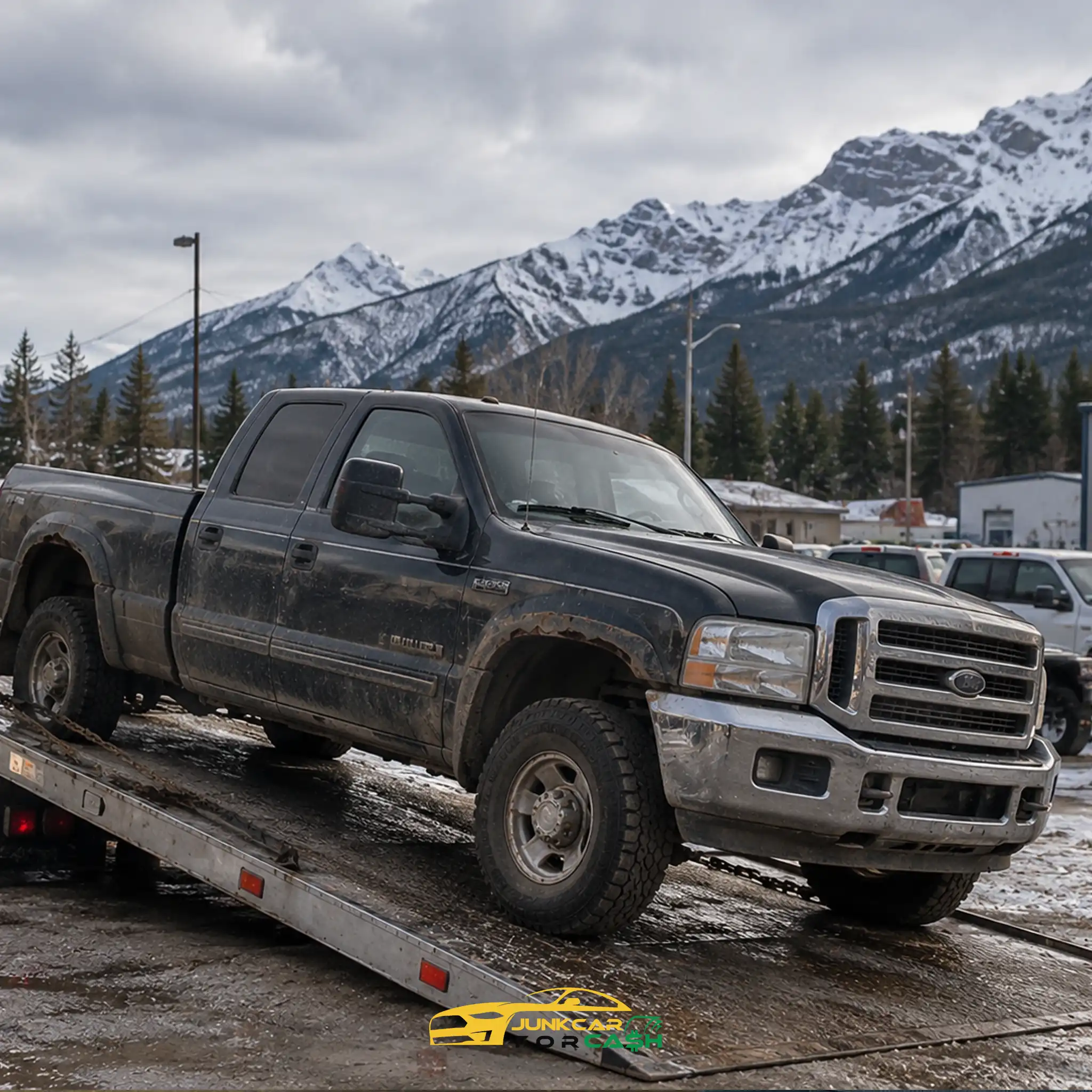
| Older half-ton on an acreage | No keys, flat tires | Junk car removal | Needs a flatbed and winch, which resale buyers may not bring |
What Is a Quick Test for the In-Between Cases?
Some vehicles sit between the two routes, and a simple calculation settles them. Estimate its resale price if it ran properly, then subtract a written repair estimate and the margin a reseller would expect to keep. If little or nothing remains, the removal quote is the realistic ceiling, and you can stop chasing resale offers. If a meaningful gap remains, a resale buyer may bid above the removal price, and the quotes from both routes will show it. The test takes one repair estimate and two phone calls. It also answers a question many sellers ask, whether to repair first: if the estimate is larger than the gap between the vehicle’s running value and what a recycler would pay, repairing before you sell loses money, and selling as is to a removal buyer comes out ahead. If the estimate is small, a repair followed by a resale can pay off.
How Long Does Each Route Take?
Speed is often the tiebreaker in the car buying services vs junk car removal in Alberta decision, because the two buyers have different jobs to finish before they can pay.
The resale route. The buyer usually needs to see the vehicle, confirm its history, and check its mechanical condition before the offer is firm. Depending on the buyer’s schedule, that can stretch across several days, and a problem found at the inspection can restart the conversation.
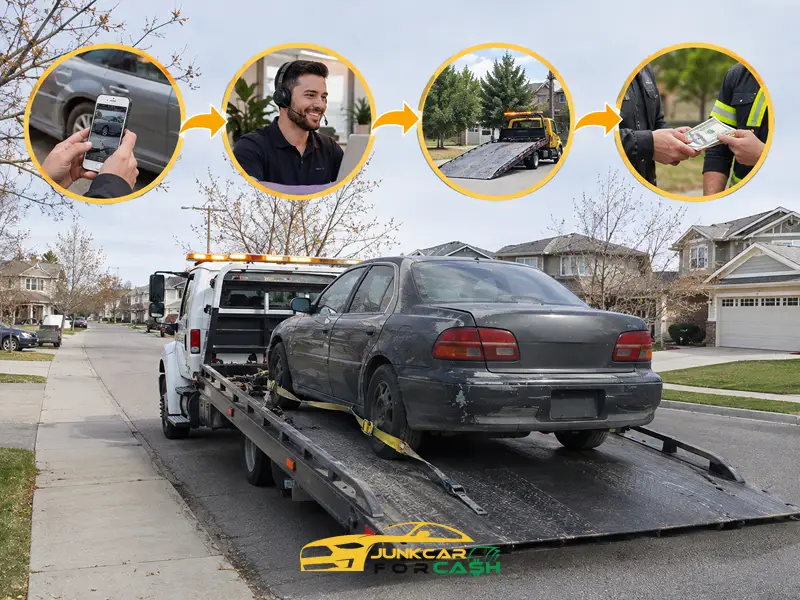
The removal route. The buyer prices from weight, completeness, and photos, so the quote can come quickly. Many removal companies offer pickup within a day or two of the call, and some can attend the same day, but availability varies by location and by how far the vehicle is from the buyer’s usual routes. Ask for a pickup window when you get the quote.
If time matters more than the last bit of price, the removal route is usually shorter. If you can wait and the vehicle is resalable, the resale route may reward the patience.
Where Can the Price Change Between the Quote and the Cash?
A quote is only as reliable as the description behind it, and each route has its own weak spots.
On the resale route, the usual culprits are findings at inspection and mismatches with the vehicle’s history. An undisclosed collision repair, a warning light that wasn’t mentioned, or a history item from the AMVIC checklist can lower the number after you’ve already cleared your schedule.
On the removal route, the usual culprits are missing components and access. If the catalytic converter, battery, or wheels aren’t on the vehicle as described, the price adjusts. So does a vehicle that can’t be reached by a flatbed because of a blocked driveway or soft ground.
You can prevent most changes by describing the vehicle exactly as it sits, sending photos of all sides, and mentioning anything missing before the buyer books a visit. A buyer who sees no surprises has no reason to renegotiate.
Does Your Location or the Season Change Which Route Works Better?
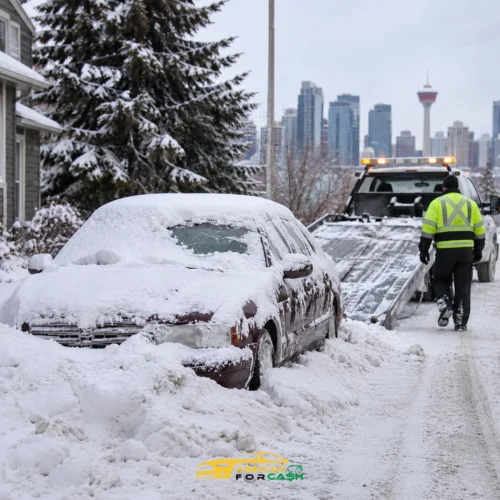
Geography and weather shift the practical side of both routes. In Calgary, buyers of either type are easy to find, but outside the city, on an acreage in Rocky View County or in a smaller town, resale buyers often expect you to deliver the vehicle or wait for their next visit to the area. Removal companies frequently advertise coverage across many Alberta communities, so confirm the service area before you count on it. Winter adds its own friction: a snow-packed driveway, frozen brakes, or a dead battery can slow a pickup of a non-running vehicle, and telling the buyer about those conditions ahead of time keeps the schedule intact.
How Do You Confirm a Buyer Is Legitimate in Alberta?
AMVIC recommends that consumers choose licensed businesses, and it publishes a database on its website where you can check whether a business is licensed. Start there, then ask which licence class covers what the buyer will do with your vehicle. An operator who buys vehicles to flip them without a licence is what AMVIC calls a curber, an unlicensed automotive sales business, and AMVIC says curbers typically sell stolen, damaged, or odometer-tampered vehicles. Watch for these warning signs when you talk to a buyer:
- No clear licence answer. A legitimate buyer names its licence class without hesitation.
- A price that shifts before anyone has seen the vehicle. Changing numbers on the phone predict changing numbers at the curb.
- Pressure to sign a blank or incomplete bill of sale. Every field should be filled in before you sign.
- Reluctance to say what happens to the vehicle. Resellers and recyclers both know their next step.
Not Sure Which Route Fits Your Vehicle?
If your vehicle is damaged, non-running, or too far gone for a resale buyer to want, a direct quote is the quickest way to see where it lands. Junk Car For Cash purchases complete passenger vehicles, from sedans to full-size pickups, whatever their condition and whether or not they start, and hands over cash at pickup once you accept a free quote that carries no strings. Towing costs you nothing, and individual parts aren’t something we buy. Call (587) 325-0717 or email [email protected] with a description and photos, and we’ll reply with a straightforward offer you can set beside any resale quote you’ve gathered.
Questions and Answers About Car Buying Services and Junk Car Removal
Which pays more, a car buying service or junk car removal?
It depends on the vehicle. A resale buyer can pay more for a drivable, clean vehicle because a resale margin exists. A removal buyer usually wins on damaged, high-kilometer, or non-running vehicles, which resale buyers may decline or price very low. Get one quote from each route for any vehicle in between.
How long does each option take from first call to payment?
Removal companies often schedule pickup within a day or two, and some offer same-day service, while the resale route usually takes longer because the buyer needs to inspect the vehicle and confirm its history. Actual timing varies by buyer and location, so ask for a firm pickup or inspection window when you get the quote.
What happens to my vehicle after each type of buyer takes it?
A resale buyer typically sells the vehicle to a consumer, another dealer, or an auction. A removal buyer typically recycles it, dismantles it for reusable parts, or passes it to a dismantler or metal recycler. Ask any buyer to explain the next step, because a clear answer is a good sign.
Does mileage matter to junk car removal buyers?
Much less than it does to resale buyers. Removal buyers price mainly from weight, completeness, reusable parts, and current metal markets, so a high-kilometer vehicle can still draw a fair quote. Missing major parts, such as the catalytic converter, battery, or wheels, matters more than the odometer reading.
Why do car buying services ask so many questions about vehicle history?
Because reselling to a consumer in Alberta requires written disclosure of history items such as fire or flood damage, past salvage status, rental use, and collision repairs over $3,000. Each item can affect resale value, so licensed resale buyers need accurate answers before they can offer a price they'll stand behind.
Car Buying Services vs Junk Car Removal in Alberta: The Deciding Question
The deciding question is where the vehicle goes next. A resale buyer pays for a car that can go back on the road and carries the obligations that come with reselling it, from written history disclosure to the Mechanical Fitness Assessment. A removal buyer pays for materials and parts and isn’t handing the vehicle to a consumer, so those consumer-facing duties don’t apply in the same way. Sort your vehicle by its realistic destination, confirm the buyer’s licence, describe the vehicle exactly as it sits, and compare quotes that cover the same terms. Sellers who follow the vehicle downstream tend to get quotes that hold up.
References
- AMVIC, Business licence classes
- AMVIC, Buying used (vehicle history disclosure, Mechanical Fitness Assessment, curbers)
- AMVIC, Mechanical Fitness Assessment
- Alberta.ca, Mechanical Fitness Assessments for used vehicles
- AMVIC, Alberta Motor Vehicle Industry Council (licensed business database)
- Alberta King’s Printer, Vehicle Inspection Regulation, Alta Reg 211/2006
- CanLII, Vehicle Inspection Regulation, Alta Reg 211/2006 (current version)