
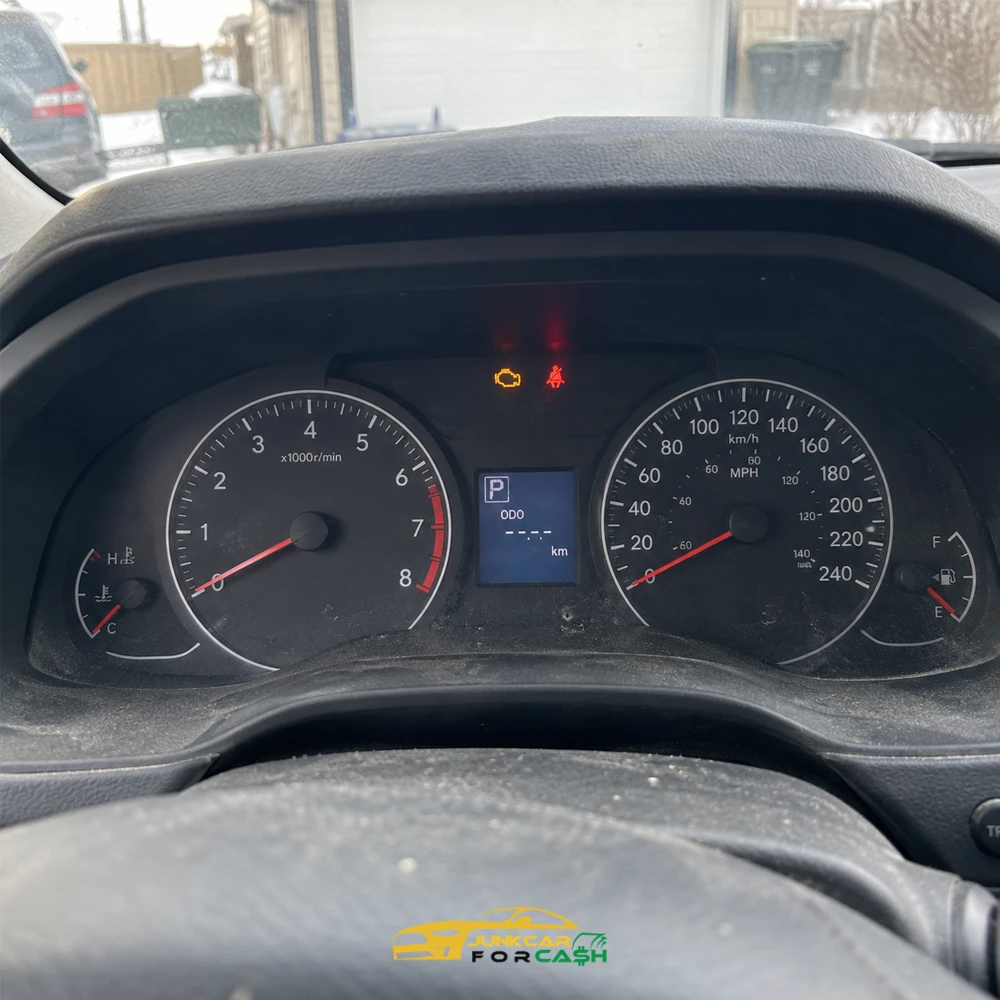
An odometer that stops working doesn’t put a car out of commission, but it does put a seller in an awkward spot the first time a buyer asks about mileage. A private buyer hears “unknown” and pictures the worst. A dealer’s history report shows a gap where a mileage figure should be. Neither reaction has anything to do with whether Alberta considers this legal, which it does, and everything to do with trust.
This guide covers what a broken odometer actually means for your sale, how to back up a mileage claim without a working one, and which buyer is realistically going to say yes.
Ready to Sell a Car With a Broken Odometer?
Whether you’ve decided to repair it or sell it as-is, Junk Car For Cash evaluates vehicles based on real condition and documented history, without requiring a working odometer first. We serve Calgary and Alberta communities across the province. Get a quote or email [email protected] for a free, no-obligation quote.
Can You Legally Sell a Car With a Broken Odometer in Alberta?
Yes. What’s illegal in Alberta is odometer tampering, intentionally altering the reading to misrepresent the vehicle’s mileage, and this can lead to real consequences, including a buyer’s right to a refund or a complaint through AMVIC. A genuinely broken odometer, one that’s simply stopped working due to a mechanical or electrical fault, is a different situation entirely. Private vehicle sales in Alberta are treated differently from sales by automotive businesses, and the dealer-specific disclosure requirements don’t apply in the same way to a private seller. That said, not being required to disclose isn’t the same as it being a smart move to stay quiet, covered below.
Does This Need to Go on the Bill of Sale?
Not necessarily. Alberta’s standard bill of sale, used for private sales, lists the odometer reading as recommended but optional, alongside a handful of other fields like phone numbers and lien information. This is different from a comprehensive bill of sale, which automotive businesses are required to use, and which must include the odometer reading at the time of sale, with a specific rule that if the reading isn’t available, the maximum odometer reading is included at the time of delivery instead.
As a private seller, you aren’t subject to that same odometer-entry requirement on the standard bill of sale, though including whatever mileage information you do have is still worth doing for the same trust reasons covered throughout this guide.
How Does a Broken Odometer Actually Affect a Sale?
More than the mechanical problem itself would suggest, because the issue isn’t really the broken part, it’s the uncertainty it creates. A buyer may have fewer ways to verify the current mileage when the vehicle’s history is incomplete, so supporting documentation becomes more important. Expect this to come up in every conversation, and expect it to cost you some negotiating room even when your actual mileage claim is completely accurate.
How Should You List and Describe the Vehicle?
Be specific rather than vague, and don’t rely on the phrase “mileage unknown” without context, since that phrase alone tends to read as a red flag. Something like: “the odometer stopped working at approximately [X] km, confirmed by service records from [date], and hasn’t been repaired” gives a buyer real, verifiable information instead of a blank space to fill in with worst-case assumptions. Have your supporting documentation, service records, past registration history, ready to show at the viewing, not something you offer only if asked.
How Do You Establish Mileage Without a Working Odometer?
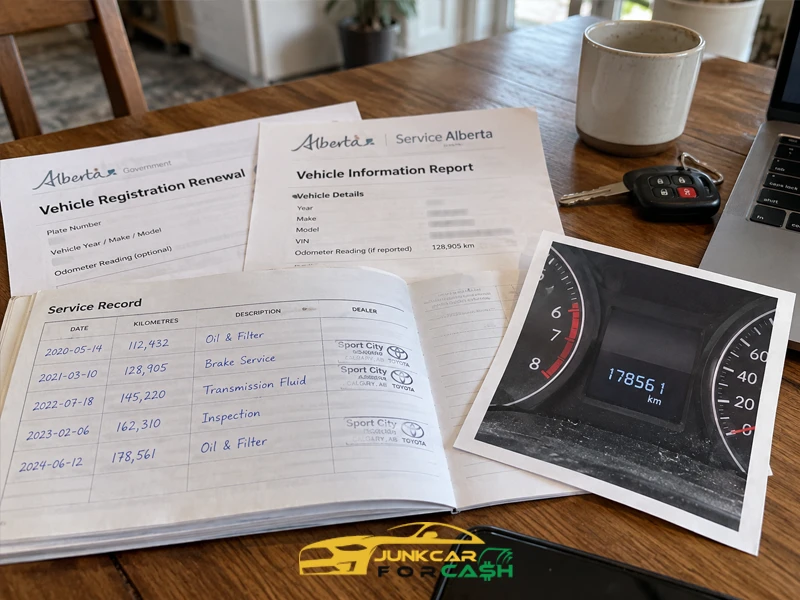
This is the practical heart of selling a car in this situation. Without a live reading, you’re relying on secondary sources to build a credible mileage history, and the goal isn’t to find one perfect document, it’s to assemble enough consistent evidence that a buyer doesn’t have to simply take your word for it. A few sources can help establish the vehicle’s mileage history when the odometer isn’t working:
- Service and maintenance records, which typically show mileage at each visit, giving a buyer a documented trail even without a current reading.
- Past registration renewals, since providing an odometer reading to Alberta Registries at the time of registering or renewing has been voluntary since 2002, which means your own past renewals may already have a recorded history you can point to. Alberta itself is clear there’s no guarantee a reading was ever reported, so this is worth checking rather than assuming.
- A Vehicle Information Report, available through Service Alberta for a fee, which may contain a previously reported odometer reading if one exists, though there’s no guarantee it will.
- Photos of the odometer from before it broke, dated if possible, showing the last confirmed reading.
- Read Also :
Proving You're Not Hiding a Rollback
Alberta.ca lists the actual signs it associates with tampering: an unusually low reading for the vehicle’s age, misaligned digits, a non-functioning trip odometer, missing dash screws, scratches near the odometer, oil change labels inconsistent with the mileage, registration information inconsistent with the mileage, and general wear inconsistent with the claimed reading.
If none of these apply to your vehicle, pointing that out directly is more convincing than a general assurance. A seller who says “the odometer stopped working, here’s my last confirmed reading and the records I have” reads completely differently than a buyer discovering it during a test drive.
Should You Repair It or Sell As-Is?
This comes down to comparing the repair cost against what it’s likely to add to your negotiating position. Costs vary by vehicle and by their problem, a simple sensor or bulb issue costs far less than a full cluster rebuild. Getting an actual quote for your specific vehicle is the only reliable way to know your real number, since pricing isn’t standardized and depends heavily on the make, model, and what’s actually failed.
A cheap, confirmed fix is often worth doing before a private sale, since it removes the immediate uncertainty around the current odometer reading. A full cluster replacement on an older or lower-value vehicle is a harder case to justify, since the repair cost can exceed what it actually improves your offer by.
Who's Actually Willing to Buy a Car With a Broken Odometer?
This varies more than people expect between buyer types, and knowing which one you’re dealing with changes both your approach and your expectations going in.
Private Buyers
A private buyer may have fewer ways to verify your mileage claim independently, so a broken odometer puts more weight on the documentation and explanation you provide than it would in a normal sale. Some buyers will hesitate the moment they hear “the odometer doesn’t work,” simply because it’s easier to move to the next listing than sort through whether the explanation holds up. The ones who stay engaged and ask questions are often genuinely weighing the vehicle rather than dismissing it outright, so treat those questions as a real opportunity to build confidence, not an obstacle.
Dealers
A dealer may be more cautious when an odometer problem creates gaps or discrepancies in the available mileage history, since dealers commonly reference vehicle history reports as part of assessing a vehicle. Being upfront about the cause and providing whatever documentation you have gives a dealer something concrete to work with, rather than leaving them to draw their own conclusions from an unexplained gap.
Direct Cash Buyers
A direct cash buyer may be worth considering when an incomplete mileage history makes a private sale or dealer transaction more difficult. Requirements vary by buyer, so it’s worth being upfront about the odometer condition and providing the records you have, the same approach that helps with any buyer type, but one that tends to matter less to a buyer who’s pricing the vehicle’s current condition rather than planning to resell it with a clean mileage history intact.
Steps to Sell a Car With a Broken Odometer
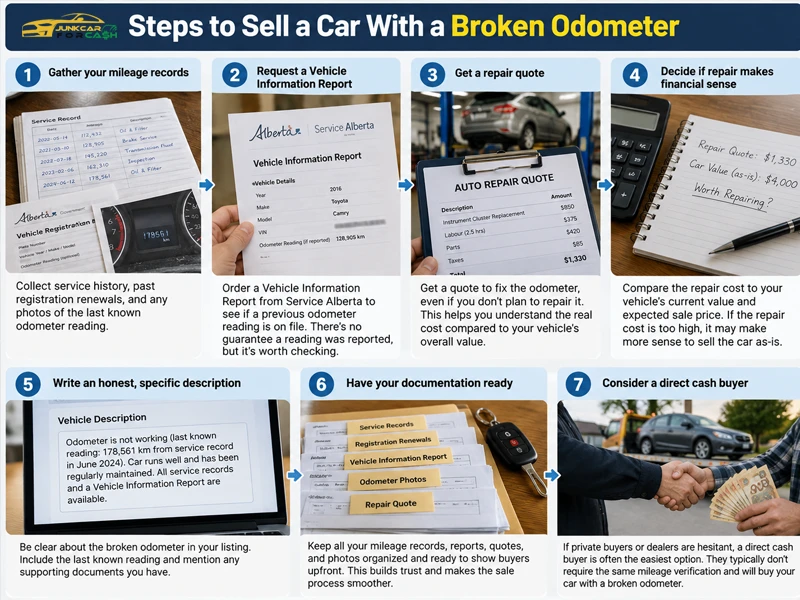
Once you’ve decided how to handle disclosure and repair, the actual process follows a fairly predictable order. Here’s how it typically plays out from start to finish:
- Gather every mileage record you have, service history, past registration renewals, and photos of the last known reading.
- Request a Vehicle Information Report if you want to check whether a past odometer reading is on file, keeping in mind there’s no guarantee one was ever reported.
- Get a repair quote, even if you don’t plan to use it, so you know the real cost of fixing it versus leaving it as-is.
- Decide whether repairing makes financial sense based on that quote against your vehicle’s overall value.
- Write an honest, specific description that addresses the broken odometer directly rather than leaving it vague.
- Have your documentation ready to show upfront, not held back until a buyer asks.
- Consider a direct cash buyer if a private sale or dealer trade-in is proving difficult, since this route typically doesn’t require the same clean mileage verification.
Expert Answers
Ready to Sell a Car With a Broken Odometer?
Whether you’ve decided to repair it or sell it as-is, Junk Car For Cash evaluates vehicles based on real condition and documented history, without requiring a working odometer first. We serve Calgary and Alberta communities across the province. Get a quote or email [email protected] for a free, no-obligation quote.
The Bottom Line
Selling a car with a broken odometer in Alberta is legal, and the real challenge is convincing a buyer to trust a mileage claim they can’t fully verify themselves. A genuinely broken odometer is a different situation from deliberate tampering, and private sellers aren’t required to disclose it the same way an automotive business must, though doing so anyway builds far more trust than staying quiet.
Gathering documentation, checking whether a past reading exists on record, being upfront in your listing, and knowing which type of buyer is actually equipped to handle this situation are what determine whether the sale goes smoothly or stalls out over a problem that’s ultimately about trust, not legality.
References
- Government of Alberta – Odometer fraud, tampering and buyer protections
https://www.alberta.ca/odometer-fraud - Government of Alberta – Standard bill of sale, required and optional fields
https://www.alberta.ca/standard-bill-sale - Government of Alberta – Comprehensive bill of sale, requirements for automotive businesses
https://www.alberta.ca/comprehensive-bill-sale - Government of Alberta – Vehicle information report
https://www.alberta.ca/vehicle-information-report - Government of Alberta – Buying a vehicle from a private seller
https://www.alberta.ca/buying-vehicle-private-seller - AMVIC (Alberta Motor Vehicle Industry Council) – consumer guidance on buying and selling used vehicles
https://www.amvic.org/consumer/buying-a-vehicle/buying-used/