
Most people assume a junk car is worth nothing more than what a tow truck charges to haul it away. That assumption costs Alberta sellers real money every year, since a non-running vehicle still carries value in its components: precious metals, reusable assemblies, and recyclable materials that buyers actively want. The confusion gets worse around catalytic converters specifically, now that Alberta has tightened the rules on how these parts can legally be bought and sold, leaving many sellers unsure what a buyer can and can’t ask for.
Understanding which parts hold real value puts sellers in a stronger position before agreeing to a quote. This guide breaks down which parts pay the most, what the Alberta catalytic converter regulation means for sellers, and how to protect your payout.
Get a Free Junk Car Quote in Alberta Today
At Junk Car for Cash, we assess the catalytic converter, engine, transmission, and every other component when we make an offer, so the number reflects what your car actually contains. We offer free towing across Alberta and pay cash on the spot for complete vehicle purchases. Get a quote or email [email protected] for a no-obligation quote.
Which Junk Car Parts Are Worth the Most Money
The base scrap value of an average car sits at roughly $250 to $500 in Canada, based on steel weight alone. A handful of specific components push that number higher, and knowing which ones matters before you agree to a quote.
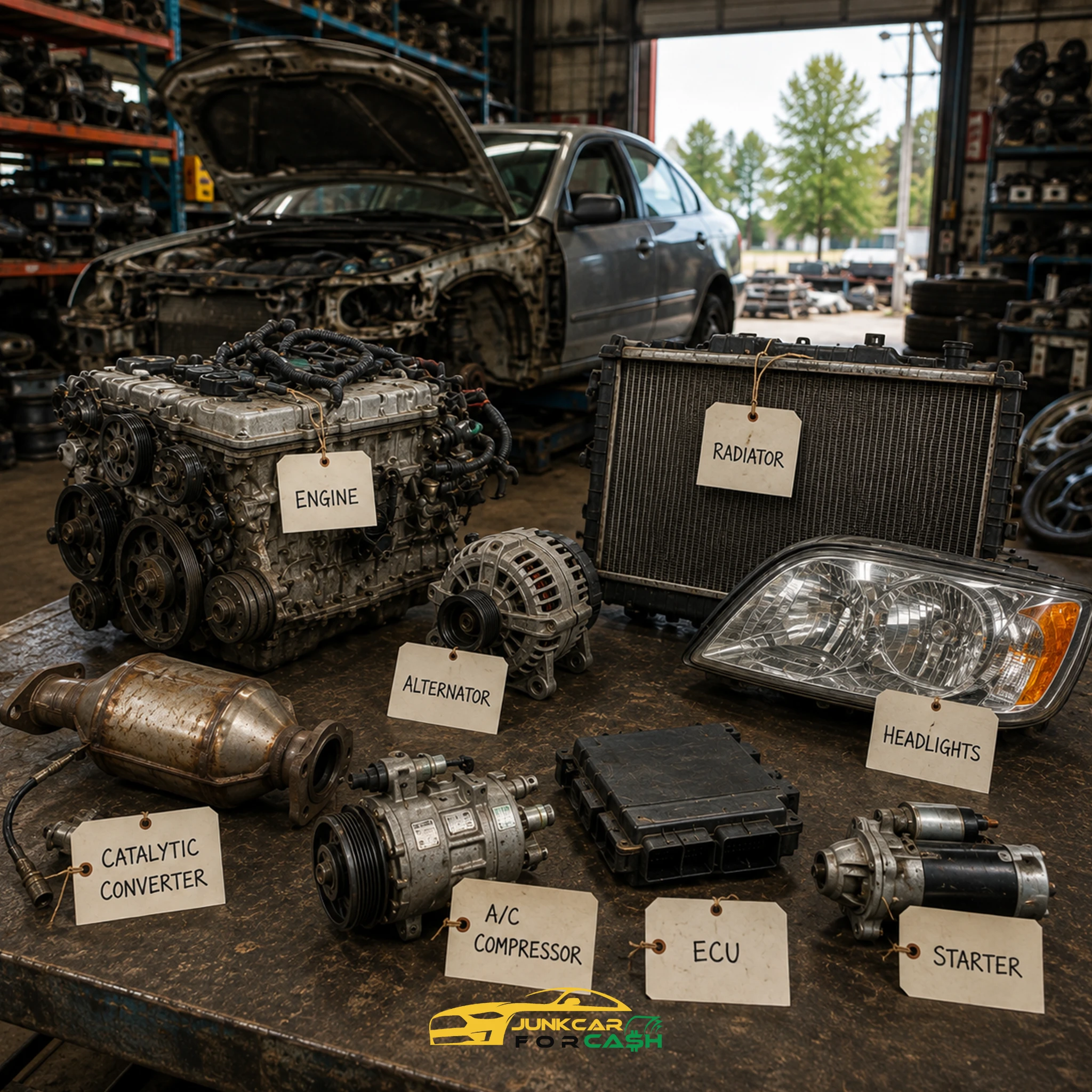
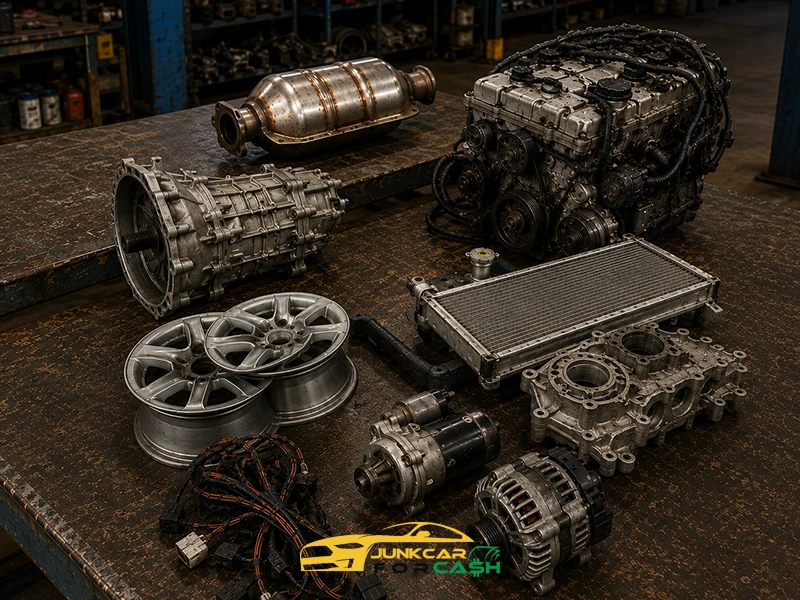
- Catalytic converter. Contains platinum, palladium, and rhodium. Standard converters typically hold $50 to $250 in scrap value, while high-demand units from trucks and hybrids can reach $300 to $700, depending on the make, model, and whether it’s an original factory unit or an aftermarket replacement.
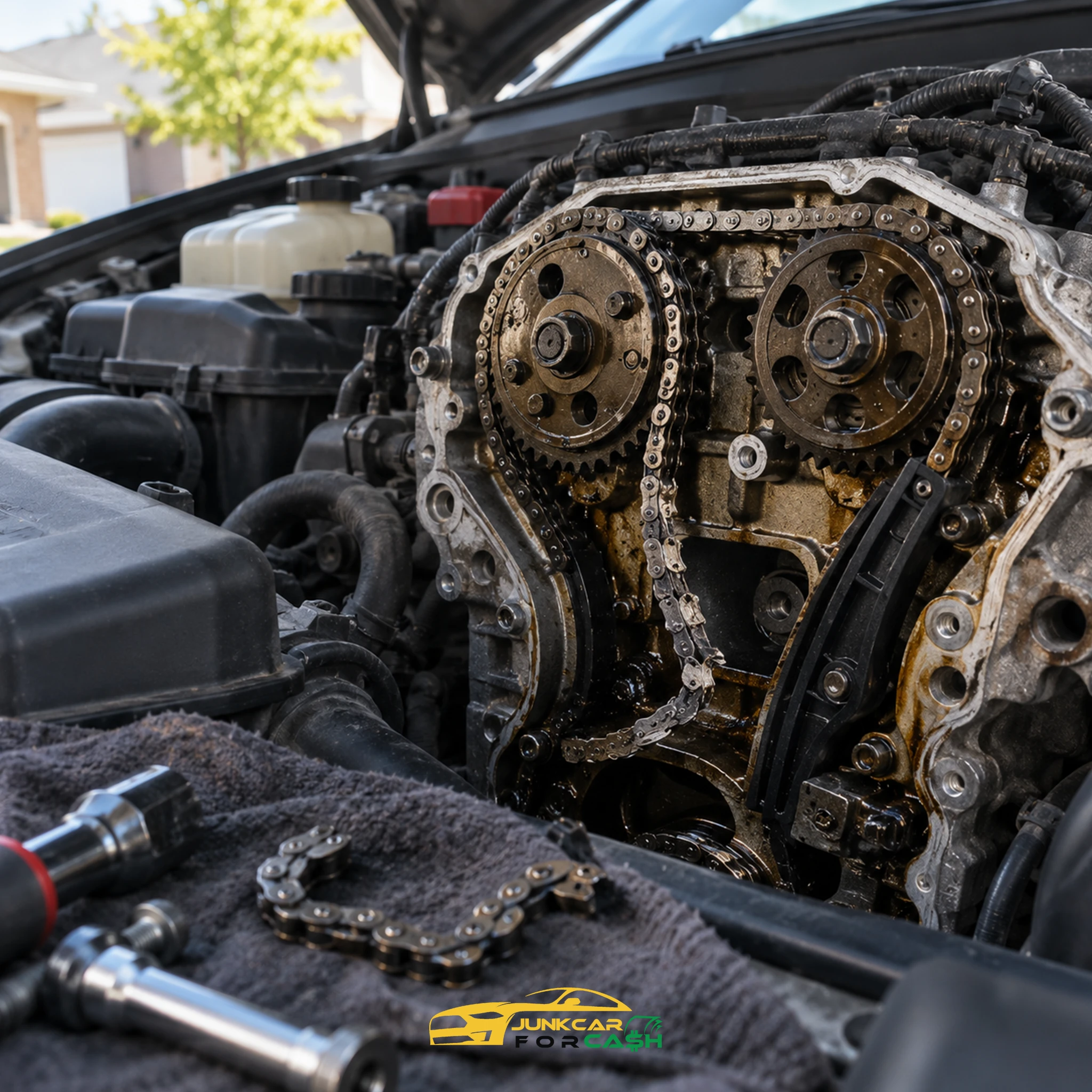
- Engine. A working engine on a common platform can be worth $400 to $1,500 to a rebuilder, while a non-running engine still holds scrap value based on weight and metal type.
- Transmission. A working unit on a common vehicle platform typically brings $100 to $400 in scrap value.
- Aluminum wheels and components. Wheels, radiators, and engine housings are common aluminum sources, and a set of four wheels alone can add $80 to $200.
- Copper wiring and electronics. Starters, alternators, and the wiring harness carry copper that adds up, especially in newer vehicles with more onboard electronics.
Alberta's Catalytic Converter Law: What Changed and Why It Matters
Catalytic converter theft has been a persistent problem across Alberta, and the province responded with legislation aimed directly at the resale market. Amendments to the Scrap Metal Dealers and Recyclers Identification Act came into force on September 1, 2025, requiring all scrap metal dealers and recyclers in Alberta to report transactions involving certain forms of scrap metal, including catalytic converters, to law enforcement through a centralized database.
Under the current rules, buyers must record the transaction date, time, dollar value, location, and a traceable method of payment, along with the seller’s name, address, government-issued photo identification, and details of the vehicle used to transport the metal. The intent is straightforward: make it harder for stolen converters to move through the legitimate resale market.
For sellers, the practical takeaway is that a legitimate buyer will ask for identification when a transaction involves catalytic converters or other regulated scrap metal, and that isn’t a red flag. It’s the buyer following the law. Sellers should be more cautious of any buyer who explicitly avoids asking for ID or documentation, since that’s more often a sign of an unregistered or non-compliant operation than a convenience.
- Read Also :
How Completeness Affects a Junk Car's Value
The condition and completeness of a junk car has a direct effect on what buyers will offer. A car missing its catalytic converter, engine, or transmission is worth meaningfully less than the same vehicle intact, since those are the highest-value components on the list above.
| Factor | Effect on Value |
|---|---|
| Catalytic converter intact | Significant positive |
| Engine present and accurately described | Positive |
| Aluminum wheels on vehicle | Positive |
| Catalytic converter cut or missing | $300 to $500 reduction |
| Engine or transmission removed | Direct value loss |
| No title or ownership documents | Adds friction, may reduce offer |
A complete car with an intact catalytic converter and a working or accurately described engine will consistently outperform a stripped vehicle at the same base weight.
How to Get More for Your Junk Car in Alberta
A few straightforward habits make a real difference in the final offer:
- Keep the vehicle complete. Removing parts before selling, especially the catalytic converter, engine, or transmission, almost always results in a lower net return once the reduction in offer is factored in.
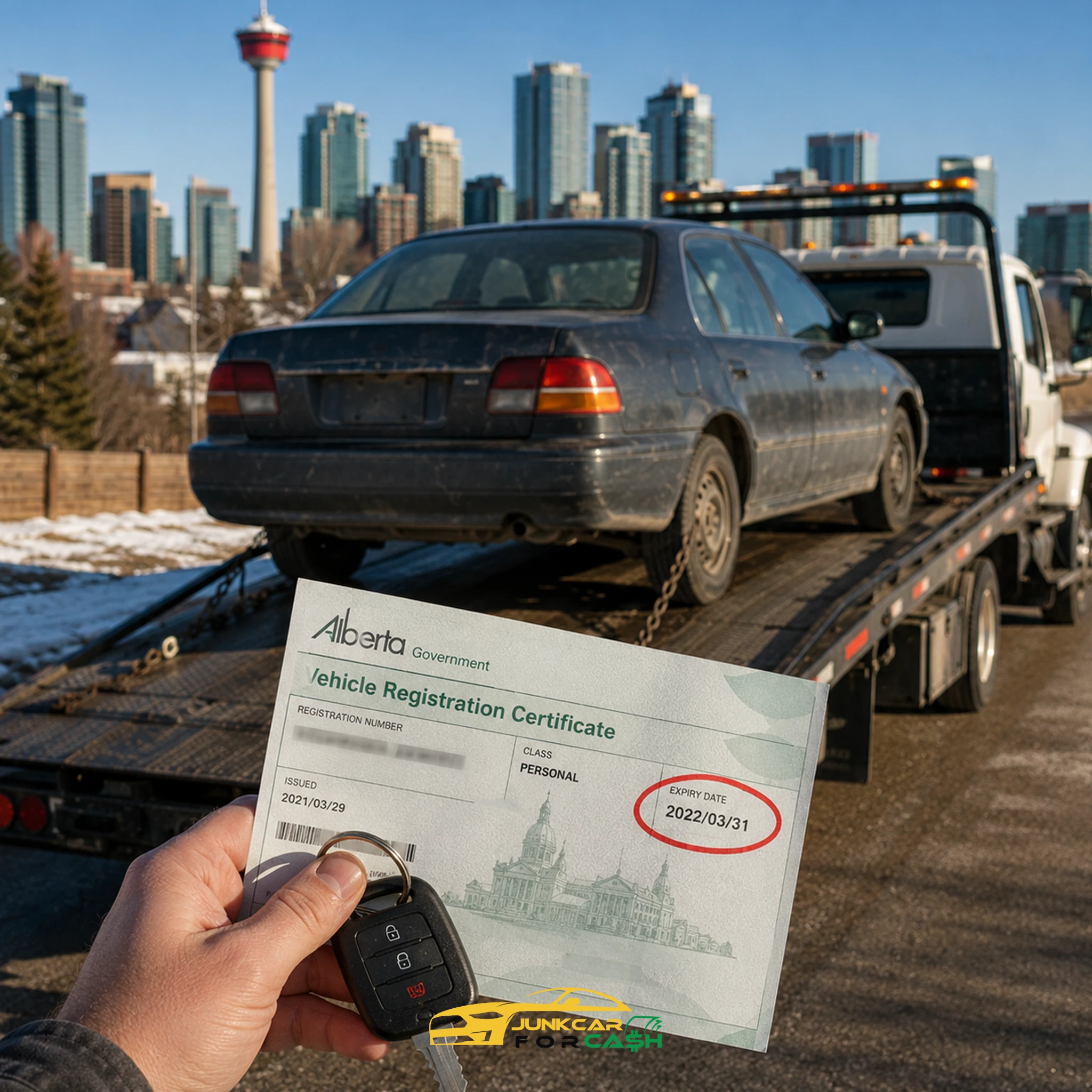
- Have ownership documents ready. A bill of sale or proof of ownership speeds up the transaction and gives buyers confidence.
- Describe the condition accurately. Telling buyers upfront what works, what doesn’t, and what’s missing avoids a revised quote at pickup.
- Compare more than one offer. Prices reflect current metal markets and parts demand, both of which vary between buyers.
Current Alberta scrap metal pricing, tracked separately from vehicle-specific parts value, puts copper around $8.88 per pound and aluminum around $2.08 per pound as of early August 2026, though these figures shift with global commodity markets and shouldn’t be treated as a fixed quote.
Frequently Asked Questions
Conclusion
A junk car’s value comes from what’s inside it, not from whether it runs. The catalytic converter is typically the single highest-value part, followed by the engine, transmission, and the aluminum and copper scattered through the rest of the vehicle. Completeness matters as much as condition, since a stripped car at the same base weight will consistently bring less than one with its major components intact and accurately described.
Alberta’s tightened rules around catalytic converter transactions add a layer of paperwork, but that paperwork exists to keep the resale market legitimate and make it harder for stolen parts to move through it. A seller with a complete vehicle and honest documentation has nothing to worry about from any of it, and is in the best position to get a fair offer the first time around instead of a revised one after pickup.
References
- Government of Alberta, “Scrap metal transactions,” alberta.ca: https://www.alberta.ca/scrap-metal-transactions
- Government of Alberta, “Scrap Metal Dealers and Recyclers Identification Act,” Open Government: https://open.alberta.ca/publications/s03p5
- Alberta Automotive Recyclers & Dismantlers Association (AARDA): https://aarda.com/About
- Automotive Recyclers of Canada (ARC), national industry association: https://autorecyclers.ca/about-arc/
- PriceOfScrapMetals.com, Alberta Scrap Metal Prices: https://www.priceofscrapmetals.com/canada/alberta/
Get a Free Junk Car Quote in Alberta Today
At Junk Car for Cash, we assess the catalytic converter, engine, transmission, and every other component when we make an offer, so the number reflects what your car actually contains. We offer free towing across Alberta and pay cash on the spot for complete vehicle purchases. Get a quote or email [email protected] for a no-obligation quote.